Lynn’s Review
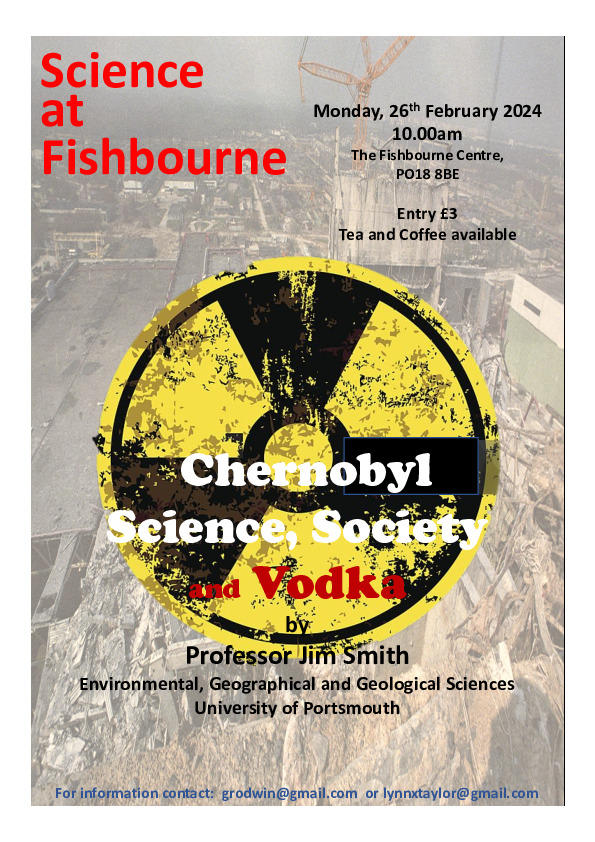
Jim has worked for more than 30 years on the environmental consequences of radioactive pollutants in the environment, and his current research interests include the Chernobyl and Fukushima nuclear accidents.
The Chernobyl Nuclear accident occurred in 1986. Explosions in the core, blew off the heavy steel and concrete lid of the number 4 reactor, sending out graphite and radioactive material into the atmosphere. Two radionuclides, the short-lived iodine-131 and the long-lived caesium-137, were particularly significant for the radiation dose they delivered to members of the public. In the first three months after the incident, 134 workers at Chernobyl suffered acute radiation sickness, and 28 of them died. Possibly a further 19 workers died in the following years.
Radioactive iodine-131, was released into the atmosphere and deposited on the ground, so contaminating the grass and leafy vegetables. The cows ate contaminated grass and some fraction of the radioactivity was then transferred to their milk. The consumption of contaminated cow’s milk was the main pathway of thyroid exposure, for iodine accumulates in the thyroid and children, having smaller thyroid glands, were at greater risk of thyroid cancer. Fortunately, radioactive iodine-131 has an 8-day half-life and so after the first two months its effects become negligible.
Giving potassium iodide tablets can block radioactive iodine-131 from reaching the thyroid gland, but they weren’t given out after Chernobyl. Tablets were distributed after the Fukushima nuclear accident in Japan in 2011 and no one was known to have suffered radiation-sickness after that event.
Caesium-137 has a half-life of 30.2 years and so is long lived
After the Chernobyl event an exclusion zone was set up, with a radius of 30kms, covering 4,200 Km2 of land. Initially 116,000 people were permanently evacuated and this number rose to 300,000.
Many sensational media reports were published, with headlines such as: “Chernobyl Survivors Face Early Death,” and “Austrians Told Not to Panic.” Later research, modelling and evaluation has shown that the immediate effects upon health were significant, but over time it has been difficult to determine which cancers and health issues have been caused by radiation from the incident, and which have been caused by general background radiation.
There are estimates that maybe in Europe 15000 lives have been shortened; by contrast, 7 million early deaths occur each year due to air pollution.
Smoking can shorten life by 10 years; the liquidators working to clean up Chernobyl may have had their lives shortened by 2-3 months.
Initially the area known as “The Red Forest,” which is close to Chernobyl suffered loss and destruction, but within a few months nature recovered. Studies between known nature reserves and the exclusion zone now show no difference between abundance and variety of animal population. Could Chernobyl now be declared a nature reserve?
It appears that the greatest impact on the human population has been with issues of mental health: 50% of the displaced people in a nearby town are unemployed and land use is not allowed. This is most damaging to the inhabitants of the area.
Professor Jim Smith has set up a project making “Moonshine” from radioactive crops, see: https://www.port.ac.uk/news-events-and-blogs/news/radioactive-free-vodka-produced-from-crops-in-chernobyl
Distillation removes the strontium-90, leaving just carbon-14, generally found in spirit beverages.
Profits from sales go to “Narodychi High School,” a school which has not been renovated since 1986.
Questions after the presentation, led to discussion as to whether perhaps nuclear energy was a better option for energy needs despite the problem of nuclear waste. Particularly considering that the UK has large stores of plutonium which could be used in mixed oxide fuel (MOX) to produce nuclear power. The main deterrent, possibly, is expense.
Links which may be of interest:
Netflix: “Our Planet.”
https://www.who.int/news-room/questions-and-answers/item/radiation-the-chernobyl-accident
https://www.ucsf.edu/news/2019/07/414976/real-chernobyl-qa-radiation-exposure-expert
https://nuclear-energy.net/what-is-nuclear-energy/radioactivity/sievert