Lynn’s Review
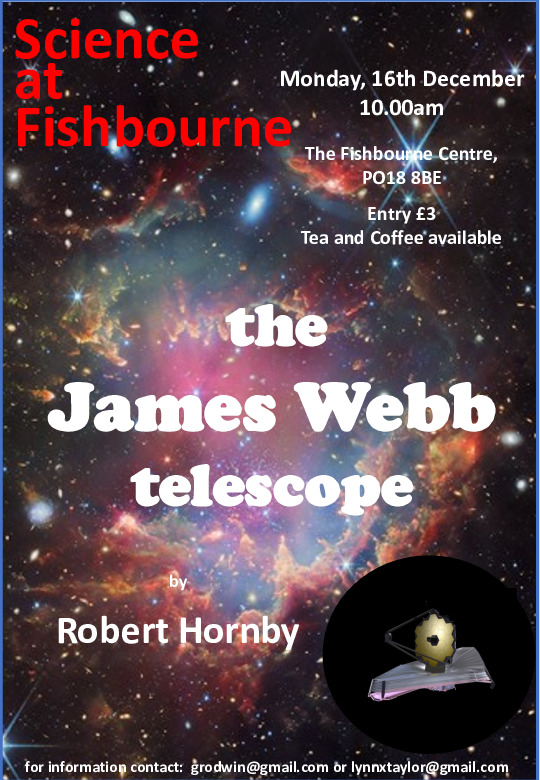
Looking up into the night sky, may fill us with wonder, and many questions will arise. Robert Hornby, helped us see the answers to some of our questions; answers being discovered by first, the Hubble and now the James Webb telescope.
The James Webb telescope is an infrared telescope, so enabling it to view back in time to over 13 billion years ago. It was launched in December 2021 and cost $10 billion. It’s immense in size, being as tall as a three-story building and as long as a tennis court.
When comparing it to the Hubble telescope, it has half the mass at 5.5 tonnes, and a mirror six times larger, with light collecting ability 6.25 times larger. The mirror consists of a hexagonal grid of 18 small, highly polished, beryllium mirrors which are gold plated, and each mirror has a motor enabling fine adjusting to position it.
The technology needed to construct the telescope is mind boggling: a heat shield was constructed to enable a cold side of -233 degrees centigrade; required for the infrared, and a warm, sunny side of 85 degrees centigrade to keep the electronics working.
The telescope has a lifetime forecast of 5 years but experience with the Hubble telescope suggests it could last at least twice as long.
The instruments on board include:
A camera, created by Arizona University; this has looked at the Kuiper belt, a doughnut-shaped region of icy bodies extending far beyond the orbit of Neptune. The camera can detect different molecules, different elements.
A Coronagraph. This can block out the brightness of a star so that anything around the star can be seen more clearly.
A Cryocooler to maintain the cold temperature necessary.
A Spectograph to analyse which chemical components make up the star or system in focus, by comparing the absorption lines of the sun with the emission lines.
A fine guidance sensor to keep the telescope steady.
It’s almost impossible to imagine how the shields protecting such a finely tuned telescope have been able to withstand a rocket launch and maintain the required temperatures for each component part.
The Hubble telescope’s orbit is 340 miles away. The JWT is 1 million miles from Earth, orbiting the Sun at a Lagrange point. Lagrange points are positions in space where the gravitational forces of two bodied systems such as the Sun and Earth, produce enhanced regions of attraction and repulsion. These can be used by spacecraft as "parking spots" in space to remain in a fixed position with minimal fuel consumption.” The JWT is at this point, “So that it can maintain a safe distance from the bright light of the Sun, Earth, and Moon, while also maintaining its position relative to Earth.”
The camera on the JWT produces images with a resolution of 150 million pixels; we have 12 million on a smart phone.
So much has been discovered already, from data collected from the JWT, and so many theories have been proven. Our advances in technology have made it possible for four and a half thousand universities to have access to the telescope for their own research projects. Collaboration is, no doubt, the way forward to advance scientific discovery. One university have collected 5 years- worth of data about the planet Jupiter.
Merry Christmas to you all. The link below will give lots more.