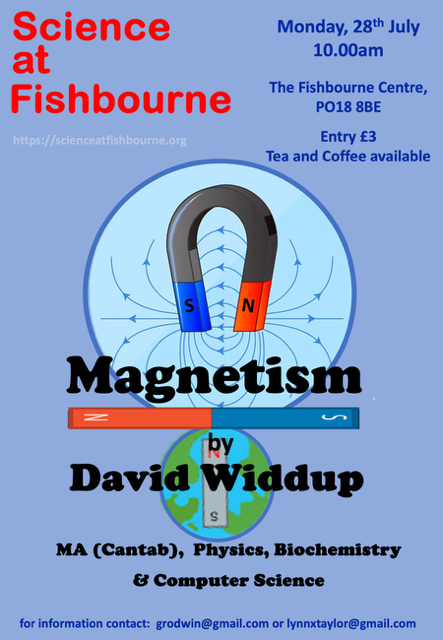
Overview
A Whistle Stop tour of the History, Materials and Applications of Magnetic Science from the Bronze Age to the Edge of the Universe (and Beyond).
Lynn’s Review
How often do we imagine that the constant motion of the molten iron alloy in the Earth’s outer core, driven by convection and the Earth’s rotation, is crucial for our survival, and the survival of all that exists on our planet? (Apologies for the length of this review … I got carried away. David inspired me to research further.)
David began his presentation with this dynamic thought. This process of action is called the Geo-Dynamo.
It creates a powerful magnetic field around the Earth: The Magnetosphere.
Without the Magnetosphere, charged particles from the Solar Wind and high-energy particles from beyond our Solar System known as: “Cosmic Radiation”, would strip away Earth’s atmosphere, including the ozone layer, making life as we know it, impossible on planet Earth.
The interaction of the solar winds and our magnetosphere can give stunning visual displays in the polar regions, known as Aurora Borealis and some of us were fortunate to see some of these effects as far south as Sussex this year. The Sun, reaching the solar maximum in its 11 year cycle, displayed more Coronal Mass Ejections which expanded the Auroral Ovals, so extending the field of view of the Aurora Borealis as Earth’s magnetic field guided the charged particles towards the Poles.
How often do we even think of magnets; the Earth’s polarity; and how it might affect us? I’ve seen a red and white striped pole stuck in the ground, when visiting Father Christmas’ toyshop in Oregon USA, but I don’t think David meant that when he explained the wandering, Magnetic North and South Poles.
The Magnetic North Pole is shifting towards Siberia, currently at a rate of around 34 miles a year. The Magnetic South pole is relatively more stable and roughly every 450,000 years the poles reverse!
The Magnetic field lines at the Magnetic poles are almost vertical, they then loop around from N to S.
The Geographic Poles are largely stationary locations where the Earth’s axis intersects its surface; the North Pole is at 90°N and the South Pole 90°S.
David told us a little about key figures in history who worked with magnetic fields and measurements; people such as Carl Friedrich Gauss; Nikola Tesla, and Pierre Curie, who discovered the critical temperature at which ferromagnetic materials lose their permanent magnetic properties.
The temperature at Earth’s interior is estimated to be 6000°C. As Iron loses its magnetic properties at 770°C, Earth cannot act like a bar magnet, so realising the theory of the Geo-Dynamo process that creates our Magnetosphere.
The Earth’s past magnetic field directions can help to identify the ages and past locations of rocks through their specific magnetic properties; this is known as Paleo-magnetism. The discovery of a volcanic ridge in the centre of the Atlantic Ocean known as the “Global Mid-Ocean Ridge,” enabled scientists to map odd magnetic variations in the volcanic rock, so also giving information about magnetic North South reversals.
Ferromagnets
Iron is a Ferromagnet. It has 26 electrons with spin; each behaving like a magnet and, in pairs, cancelling each other out. It has 4 un-paired electrons. These will line up to create atomic magnets. The alignment of individual atoms, when interacting with neighbouring atoms, produces magnetic domains. These magnetic domains, being randomly oriented, produce a magnetic field of almost zero, but iron, once exposed to an external magnetic field, becomes strongly magnetic as the domains align, and retains this property even after the external magnetic field is removed. Other Ferromagnets are: nickel, cobalt and gadolinium.
Paramagnets
Paramagnetic materials react to external magnetic fields but don’t retain strong magnetic properties once the external source is removed. Some examples are: aluminium, oxygen (O2), titanium, iron oxide (FeO), magnesium, molybdenum, and various transition metal complexes like myoglobin.
Diamagnets
Diamagnets don’t have any permanent magnetic moments. When placed in an electronic field, they weakly repel the field, resulting in a small negative magnetic susceptibility. Some examples of diamagnets are: copper, nitrogen and barium sulphate. Most body tissues are diamagnetic; tissues containing iron-based proteins or metal implants will exhibit other characteristics.
Magnetite
A Lodestone is a naturally magnetised piece of the mineral Magnetite. Magnetite was used in the Han Dynasty to create a South pointing ladle. It would be placed on a cast bronze plate, carved with auspicious trigrams and directions, for use in Feng Shui and Geomancy. Later, it was used for navigation.
Rare Earths
Today rare earth materials such as Neodymium and Samarium are used to make strong magnets. Neodymium magnets enabled the miniaturisation of electronic devices such as mobile phones. They are stronger, permanent magnets than Samarium Cobalt magnets, whereas they can’t operate in such high temperatures. Samarium Cobalt magnets are more expensive, but their high-temperature stability and corrosion resistance make them better for use in aerospace, generators and motors. They aren’t recommended where high impact is required, being more brittle.
Ferrofluid magnets are used in conjunction with Neodymium magnets. They have friction reducing capabilities when applied to the surface of Neodymium.
A simple electromagnetic motor (after Michael Faraday’s discoveries) is a homopolar motor and a link below gives detail. Fleming’s Left and Right Hand Rules can be used to show the direction of: the magnetic field, current and force and details are in the link below.
Modern Uses of Magnets
There are many modern uses for magnets and these include: recycling systems; Food product decontamination to remove any metals; MRI scanners; maglev trains; concrete shuttering with magnetic clamps; trans-cranial stimulation; Degaussing of ships (details in link below); shark repellent and surgical tools to locate shrapnel.
Galactic Magnets and Magnetic Fields
Theoretical models are still developing to understand these galactic fields which pervade the Universe, including our Solar System. The Dynamo mechanism is thought responsible.
It’s thought that Magnetic fields can influence phenomena like the formation of spiral arms and galactic outflows; they perhaps have the potential to affect the overall evolution of galaxies.
Many interesting questions followed David’s talk and the Bermuda Triangle was mentioned. There was some discussion, and David mentioned that there are variations in the Earth’s field. It isn’t the same everywhere.
I found this on the internet: The Earth’s Magnetic field varies, particularly over the South Atlantic Ocean. Here Van Allen’s radiation belt dips closest to Earth’s surface because of a localised weakness of the earth’s magnetic field. This can cause electronic equipment in spacecraft to behave unpredictably.
Whilst writing this, I also discovered that our brains contain Magnetite and I found this on Wikipedia:
“Some researchers also suggest that humans possess a magnetic sense,[66] proposing that this could allow certain people to use magnetoreception for navigation.[67] The role of magnetite in the brain is still not well understood, and there has been a general lag in applying more modern, interdisciplinary techniques to the study of biomagnetism.[68]”
There are links below for more information.
https://www.studentsinmagnetism.org/earth-is-not-a-bar-magnet
This link includes a simple interactive example (fun)
This link explains homopolar motors and has a video
Fleming’s Rule
https://byjus.com/physics/flemings-left-hand-rule-and-right-hand-rule/
Degaussing
https://www.semshred.com/the-history-and-science-of-degaussers/
Brains
https://discoveryalert.com.au/news/magnetite-human-brain-properties-functions-2025/