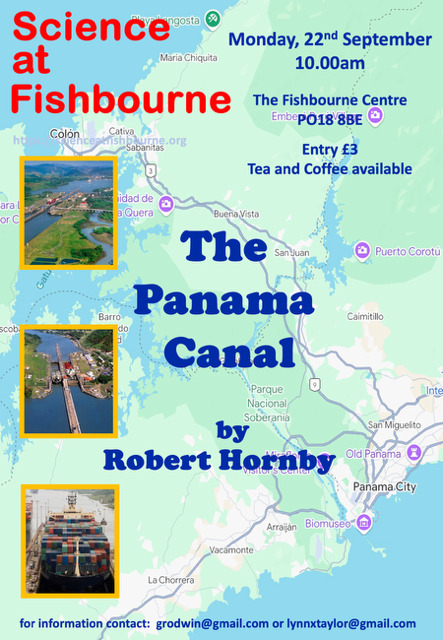
Overview
This talk will include how it was started, the dangers for the workers, the incredible machines invented to build the canal, the skill of the surveyors to find the appropriate site for daming the river and finally how locks work. It will also include types of ships that pass through this waterway and what has been done to future proof the canal.
Lynn’s Review
Bob is a popular speaker. His varied career began in the Royal Navy where he studied to become an engineering officer. He worked on the 909 Cedar missile systems, then worked with Texas Instruments. The idea for his talk today, was conceived after he experienced a journey through the Panama Canal, on his voyage to New Zealand, where he lived for three years.
Bob introduced us to the history of canals, the earliest being in China in 3000BC. In England the first canal was opened in 1761. It was commissioned by the 3rd Duke of Bridgewater so that he could transport coal from his mines in Worsley to Manchester. The engineer responsible for the building of the Canal was James Brindley and he paved the way for Narrow Boat Canals. Engineers such as Thomas Telford were primarily responsible for building wider canals, in order to accommodate larger vessels.
A key component of a canal is the lock and there are various kinds which work by gravity:
The Pound Lock was invented in Mediaeval China and comprises a chamber with gates at either end, so enabling the water level in the chamber to be raised or lowered by opening one or other of the gates.
The Broad Lock can accommodate 2 boats.
The Double Lock can accommodate 2 boats side by side.
A Flight of Locks may be necessary where the terrain isn’t level.
The Suez Canal has no locks.
The journey around the southern tip of South America is long and hazardous, and much discussion was given, over the centuries, to the creation of a canal which would join the Atlantic and Pacific Oceans:
Charles the 5th of Spain in 1534 was looking for an easy route from Peru to Spain.
In 1668, Sir Thomas Browne suggested that a cut through the isthmus would make a faster route to the East Indies.
In the late 1690s there was a Scottish plan to establish a trading colony in the Darién region of Panama with an overland route connecting the Atlantic and Pacific Oceans, but it failed due to disease, Spanish resistance, lack of supplies and English opposition, resulting in thousands of deaths and much financial loss to Scotland.
In 1788, the Americans suggested that the Spanish should build a canal, but there was insufficient economic motivation, and a lack of technology.
In 1850, the Americans did build a railway across the Panama isthmus and it was recently used when water levels fell in the Panama Canal. It was also used when the building of the canal finally began.
In 1881, the French engineer Ferdinand de Lesseps, having built the sea level Suez Canal, began on the construction of a sea level canal for Panama. The project was abandoned in 1889 due to tropical disease causing the death of 25,000 workers; financial issues and engineering problems. A sea level canal, anyway, wasn’t feasible because of the nature of the terrain. The company went bankrupt and the project was later taken over by the Americans who completed it in 1914 at a cost less than they budgeted for.
The Panama Canal is a remarkable feat of engineering and adjustments to its design are ongoing.
The Americans were also troubled by tropical diseases whilst building the canal. The discovery by Major Ronald Ross, in 1897, that female mosquitoes transmitted malaria, and the subsequent sanitisation of the canal zone, led by Colonel W C Gorgas, helped to improve the situation.
(In England, it was the entomologist John Marshall who paved the way for British mosquito control. He did his research locally on Hayling Island, identifying 17 different types of mosquito there, 4 of which could carry malaria. His work led to the establishment of the British Mosquito Control Institute in 1925.)
The first ship passed through the Panama Canal in 1914 and initial improvements to the canal continued throughout the 1900s.
In 1999 the Americans gave complete control of the Panama Canal to the country of Panama.
The Panama Canal is an important trade route used by 170 countries.
There were 14000 transits in 2023. The Panama Canal, therefore, has great strategic importance and is currently a topic of concern for the USA, who fear that China has financial interest in the ports. There have been significant trading deals this year.
It’s interesting to note that 52 million gallons of water are used for each transit. The height difference between the Pacific and Atlantic oceans is 85 metres. This necessitated a series of stepped locks initially Mitre Locks, which were invented by Leonard Da Vinci in the 15th Century, now supplemented by some massive sliding gates.
The engineering feats achieved in the building of the Panama Canal necessitated the creation of extensive machinery such as: drills, cranes, dredges, giant hydraulic rock crushers, cement mixers, and pneumatic power drills.
Ships passing through the canal must all undergo underwater hull clearing. This can take several hours. The reason for this I looked up, after Bob’s talk, and here is a link that explains it:
https://marinesupercargo.com/nderwater-ship-hull-cleaning-in-panama/
Basically, the reasons given are: removal of marine matter on ships hulls reduces friction and increases fuel saving and therefore less greenhouse gas emissions; helps prevent corrosion; makes hull inspection easier, and helps prevent the transfer of invasive marine species from one ocean to another.
The cost of a hull clean for a container ship is $200,000.
The Panama Canal revenue collected in 2023 was 5 billion dollars.
I’m sure that a journey through the Panama canal is an amazing experience and we have all benefitted from Bob’s voyage through it.