Overview
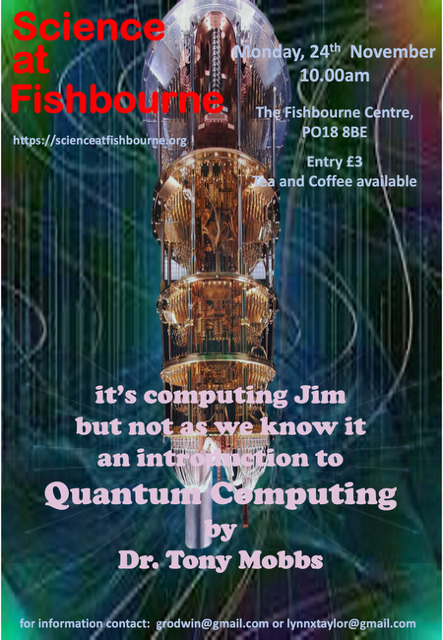
Quantum computing is a revolutionary approach to computation that harnesses the principles of quantum mechanics. Unlike classical computers, quantum computers utilise the phenomenon of quantum principles. This enables quantum computers to solve certain problems much faster than classical machines. Though still in early development, quantum computing holds promise for breakthroughs in many scientific disciplines and could potentially transforming industries and scientific research in profound ways.
Lynn’s Review
This was a subject of great interest to the members of Science at Fishbourne, as indicated by the number of people who turned up to listen to Tony, and we weren’t disappointed. Quantum is fuzzy so no one was expecting true enlightenment, but we were all captivated by Tony’s talk and there was much discussion afterwards.
Tony began with some history of the Atom, beginning with a definition of the word itself, which came from the Greek: Atamos, which means: uncuttable. It was Democritus 460BCE-370BCE who noticed how steps became worn down over time as people walked up and down them. He realised that friction from footfall was causing particles to rub off the steps. There must therefore be, tiny particles.
Over time, other scientists put forward their theories and discoveries:
1803 John Dalton – matter is made from little balls which form elements. Atoms of one element are all alike but they differ from atoms of other elements.
1897 JJ Thompson – Atoms had charges.
1911 Ernest Rutherford – Atoms had a nucleus.
1913 Neils Bohr – Electrons go around the nucleus (Nobel prize in 1922)
1919 Rutherford - identified the proton as the fundamental particle within the nucleus. The nucleus contains protons, giving it a positive charge.
1869 Mendeleev - He organized known elements by their increasing atomic weight and properties, forming the basis for the modern periodic table.
In the 20th Century CERN opened on the French Swiss border. It is about 100 metres underground and its particle accelerator consists of a ring tunnel of 27 kilometres. Here atoms are accelerated at super high speed and their collisions cause particles to fall off. These particles, in the 1960s were given the name Quarks. Quarks have mass, a fraction of charge and spin. There are also Leptons. Quarks and Leptons are the two fundamental types of elementary particles that make up all known matter. They are collectively called Fermions.
Other particles: Bosons; such as Gluons and Photons are force carriers and they mediate the fundamental forces between the Fermions.
In 2012, the Higgs Boson was discovered at the Large Hadron Collider at CERN. This discovery confirmed the existence of the Higgs field and its associated mechanism. The Higgs Boson is an excitation of this field and it gives mass to other elementary particles.
There are also Neutrinos. These have no charge and very small mass and maybe they give some – as yet unexplained- magic to our lives (my suggestion), as tens of trillions of them, stream from the Sun, passing through our bodies every second.
Tony explained lots more, about protons, neutrons, charges and spins, but perhaps further reading on this is a good idea.
In the 17th Century Isaac Newton proposed that light consists of tiny particles called corpuscles and Charles Huygens proposed that light was a wave. Modern physics recognizes that light is not strictly one or the other, but exhibits both wave-like and particle-like behaviours depending on how it is observed or measured.
Max Plank in 1900 discovered the Quantum theory. He proposed that the energy from a heated object is not continuous, but comes in small, discrete units (quanta). This idea solved the problem of black- body radiation, a phenomenon that classical physics could not explain. He also introduced the fundamental constant ℎ to define the energy of a quantum. This constant is now a cornerstone of quantum mechanics.
Albert Einstein won the Nobel Prize in 1922 for his discovery of the law of the photoelectric effect. This explains the relationship between Electron emission and light frequency. Light consists of small packets of energy called photons.
Thomas Young in 1801 demonstrated that light had a wave nature by conducting the double slit experiment. (see link below).
Other Scientists referenced by Tony, include Louis de Broglie; Max Born and Erwin Schrodinger.
Unlike classical physics, Quantum events have inherent probabilistic outcomes, and Tony gave some physical examples relating to Kinetic and Potential energy. Holding a length of string, each end being held in each hand, and one end having a weight attached, he explained that in this horizontal position, potential energy was displayed. Upon releasing the end with the weight, Kinetic energy came into play as the weight swung downwards in an arc.
Probability waves are a concept of Quantum mechanics. The wave like nature of a particle represents the probability of finding it in a particular location. Electrons don’t move around a nucleus in neat orbits but move as in a cloud. The probability as to the position of any one electron; it could be anywhere. When you locate it, then the probability wave collapses because you know where it is. Schrodinger’s cat thought experiment relates to this concept.
Waves also have preferred patterns depending on the amount of energy in them and Tony demonstrated possible orbital regions where electrons might be found around a nucleus, by putting energy into a length of string.
A I gave me these words to attempt to explain Tony’s demonstration of the S,P,D and F orbitals:
“Think of them as different "rooms" for electrons, each holding a specific number of electrons: s is a single, spherical room (2 electrons); p are three dumbbell-shaped rooms at right angles (6 electrons); d have a four-leaf clover shape and are more complex (10 electrons); and f orbitals have even more complex, varied shapes (14 electrons).”
Superposition is a fundamental principle of Quantum Computing. In superposition an object can be in more than one quantum state until you measure it.
Entanglement is also a fundamental principle of Quantum Computing. It connects particles that are linked. Entanglement can happen, over any distance, from a physical collision or from sharing a common origin. Tony asked us to imagine a pair of gloves. If we place one in a box and have another on our right hand, we know that the one in the box is the left hand. The pair are linked even if the box is far away.
The computers we use at home are “Classical Computers.” They use bits to represent data using 0s and 1s. These are like, on /off switches. For example, to calculate 3 X 5, the numbers are first converted into binary they are processed through many logic gates and the answer emerges in a fraction of a second.
Quantum Computers use qubits. This is a system that can be in superposition of two different states at the same time: both 0 and 1. They can therefore perform many calculations at the simultaneously. Their power is boosted by entangling qubits. The quantum particle must be kept, just like a spinning coin, in a coherent state. Qubits behave in a probabilistic manner. They will run the same calculation multiple times and return a set of probabilities rather than a single number.
One of the problems faced is the ability to maintain coherence – the freedom from outside interference. Environmental effects such as noise and vibration will interfere with the Quantum computer.
Classical computers perform the everyday tasks, which we use, very well. Quantum computers are currently massive: IBM’s D Wave computer is 7-8 feet tall. Their use is for breaking modern encryption; simulating molecular interactions for drug discovery and solving large-scale optimisation problems such as supply chain logistics. They can solve complex statistical problems in finance and perform accurate scientific simulations.
A quantum computer can’t be used to send a signal because the outcome of measurement is probabilistic. you only know how the two measurements will be related.
I have enjoyed attempting to write this review, and truly enjoyed Tony’s presentation. Now …. So many more questions …
I hope you find the links below useful too ..
A Book I have enjoyed is: “How to Teach Quantum Physics to Your Dog” by Chad Orzel.
Also, all books by Carlo Rovelli
Jim Al-Khalili describes the double slit experiment
https://youtu.be/A9tKncAdlHQ?si=h3OHnhngwKEM3ty6
Louis De Broglie
https://www.nobelprize.org/prizes/physics/1929/broglie/biographical/
Max Born
https://www.nobelprize.org/prizes/physics/1954/born/facts/
Erwin Schrodinger
https://en.wikipedia.org/wiki/Schrödinger%27s_cat
“Start the Week,” with Professor Paul Davis speaking about Quantum Technology. He wrote the book: “Quantum 2.0”
https://www.bbc.co.uk/sounds/play/m002n05z?partner=uk.co.bbc&origin=share-mobile
Also (Just for interest) Paul Davis YouTube video on Multiple Universes
https://youtu.be/pGtb-6WOpuk?si=zlreuDRnIGSYkWLM
Chinese scientists build a stable block for Quantum Computers.
https://quantumzeitgeist.com/quantum-computers-quantum-computing/
Quantum for Dummies… is my level!
https://www.dummies.com/article/technology/computers/what-is-quantum-computing-300551/
IBM Quantum platform
https://quantum.cloud.ibm.com/
.