Lynn’s Review
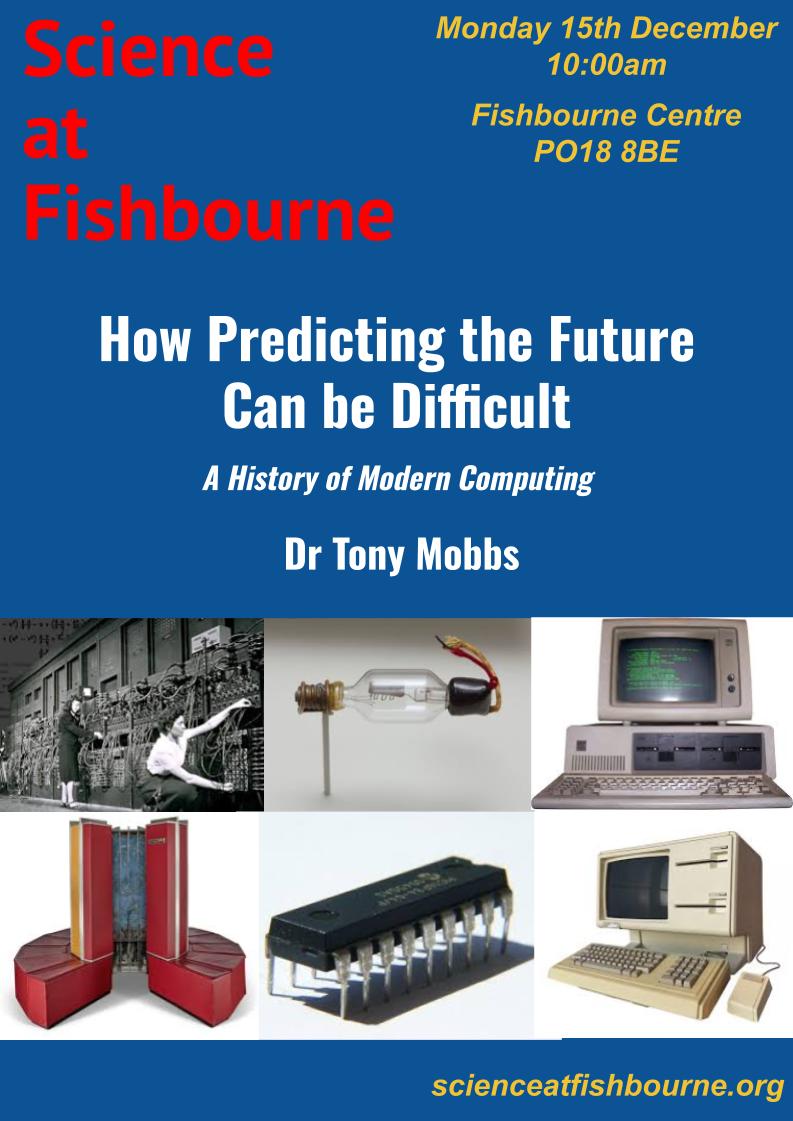
Many of us may have received manipulated video clips instead of Christmas and New year cards this year, so the pace of change, and the power and versatility of computing is evident. Tony’s presentation gave some background history to the changes we experience almost daily, and there was much discussion on what the future might hold.
Neils Bohr was Tony’s starting point with a quote attributed to him:
“Prediction is very difficult, especially if it’s to do with the future.”
Further quotes from the presentation showed how wrong some predictions can be. Sometime in 1943, Thomas Watson -the chair of IBM- massively underestimated the future of computers when he suggested: “There is a world market for maybe 5 computers.”
The word: computer originally described a person who drew up a calendar. Today we understand computers to be very different, so how did it all begin and where might we be heading?
Maybe it all began with Herman Hollerith, who in the 1880s, developed his revolutionary electromechanical punch card system for statistics. It was based on the French Jaquard textile loom and contained one row of code. His “Tabulating Machine Company,” eventually became International Business Machines in 1924.
Early computers used gears and levers; an example is Charles Babbage's Analytical Engine. Although it was never fully built, it paved the way for progress.
War and conflict can drive progress. Creativity and innovation are vital when considering how to defend a country, and finance is given to the military during these times for the creation of new devices to assist in defence. The 2nd World War saw the invention of the vacuum tube and a shift from mechanical to electronic computing which was faster and more reliable. Colossus was the first programmable electronic computer, built and used at Bletchley Park to break a complex German cipher. It was designed by Tommy Flowers and it used 2½ thousand vacuum tubes.
The ENIAC computer was built at Pennsylvania University and was the first programmable general purpose computer; not one for the home though as it weighed 30 tons and used 17,468 vacuum tubes! The mean time before failure of the system was 1½ hours.
The Mechanic Magazine at least realised that the size of computers would reduce when this prediction was published: “Computers in the future may weigh no more than 1½ tons.”
Between 1956 and 1963, transistors replaced vacuum tubes and computers became smaller and more reliable. IBM’s 1401 computer weighed only 5 tons and was roughly the size of two refrigerators. Over half the world’s computers were 1401s by the mid 1960s. It processed from punched cards and used magnetic tape for storage and retrieval. Payroll, inventories and billing could all be processed on this computer. Since then computers have continued to advance and progress. IBM’s 7090 cost 3 million dollars and could be rented by the month.
From transistors we move to integrated circuits. Seymour Cray, in 1964 introduced the CDC 6600. This used silicon transistors and 10 small processors rather than one system. This was deemed a super computer working at speeds faster than its rivals at IBM. It cost 24 million dollars. He soon improved on this with the CDC 7600, which ran at 5 times the speed of the CDC 6600. To this he pipelined the units so that instructions for calculations could be fed in, without waiting for the last calculation to finish. Function units could work in parallel and there was no queueing to input instructions. Dr Mobbs had experience of working with one of these machines, which being 6ft X 10ft he likened to a deity surrounded by men in white coats with offerings.
There are now many computer languages to learn, but FORTRAN70 was used then and is still in use today.
1981 saw the advent of Personal Computers with IBM’s Model 5150 which cost just over 1½ thousand dollars. The operating system was Microsoft’s MS-DOS (I remember going to evening classes to learn how to use MS-DOS). There was a floppy disc drive and 64K of memory. This development spurred the, now dominant software and hardware industries associated with computing.
Acorn Computers built the BBC Micro -computer, as part of the BBC’s literacy programme. Most schools in the country had one. They cost from £299 and had a notable impact on education and on the UK’s home-grown software industry.
In 1984, Amstrad launched a home computer, the CPC 464 It cost from £249 and 3 million were sold over its lifetime.
In the 1980s the Apple Corporation worked on the Lisa project: a computer with a drop down menu bar; windows; a file system; a copy and paste function; folders, and a mouse. Steve Jobs, co-founder of Apple was forced out of the project. He took up Jef Raskin’s Macintosh project and sales of the Apple Macintosh computer surpassed those of Apple’s Lisa.
Microsoft was founded in 1975 by Bill Gates and Paul Allen, after working on, what was considered to be, the first commercially successful personal computer: the Altair 8800 computer. This was produced by Ed Roberts’ company Micro Instrumentation and Telemetry Systems. MITS suffered from cash flow problems and the brand disappeared.
Microsoft launched their Windows 1.0 in November 1985 and this led to Windows being the most popular desktop operating system in the world.
Vannevar Bush in 1945 wrote about the underlying idea of creating and following trails of information on microfilm, and in 1989 Tim Berners-Lee created the first World Wide Web pages. The WWW is the system used for the implementation of Hypertext (a term first mooted by Ted Nelson in 1963). Hypertext is the concept of allowing links between documents, as suggested by Vannevar Bush, and the WWW provides the infrastructure of clickable links enabling jumps from one document to another.
The shape and evolution of the WWW was standardised in 1994. Mosaic, was the first user friendly web browser in 1993. It made the internet accessible and led to the Dot Com Revolution and Boom, between 1995 and 2000.
The first commercially available mobile phone was released by Motorola in 1984. It cost $4,000, gave 30 minutes of talk time and took 10 hours to charge.
Apple’s first Smartphone arrived in 2007. It combined a phone, an ipod and an internet device with a touch screen. The latest iPhone 17 (launched in September 2025) it has a Light Detection and Ranging Scanner so enabling in depth maps and better auto focus on the camera, together with better low light photography. 30,000 invisible dots are used to make a map of your face (face ID can be used to open your iphone).
Transistors have been getting smaller and smaller. They now measure on the atomic scale at 3 nanometres wide; DNA is 2.5 nanometres wide. Further shrinking would be either too expensive or become impossible.
The speed of computing has also increased; the first commercial systems measured performance in thousands of operations per second (FLOPS), whereas modern personal devices operate at trillions of operations per second (teraFLOPS) or even higher.
We are now heading towards autonomous cars becoming widespread and the 5th generation of computing: Synthetic Intelligence: autonomous, emergent thinking systems. We now have AI tools such as ChatGPT, Gemini, Claude, Copilot and Grok. There is, and will be, great social impact with potentially 100,000 jobs lost, even those of university graduates. Robotics are used not only in such industries as car manufacturing but also in military applications - 70% of the Defence Advanced Research Projects Agency’s programmes have made use of Robotics and machine learning.
Currently, China, USA, Canada and Tesla take the lead in the manufacture of Humanoid robots.
Where do we head next? We return to Tony’s heading for this talk: “Predicting the future can be difficult”. Let’s hope for the continuation of humanity and creativity, with a foundation of love not fear.
Happy New Year to all at Science at Fishbourne!