Lynn’s Review
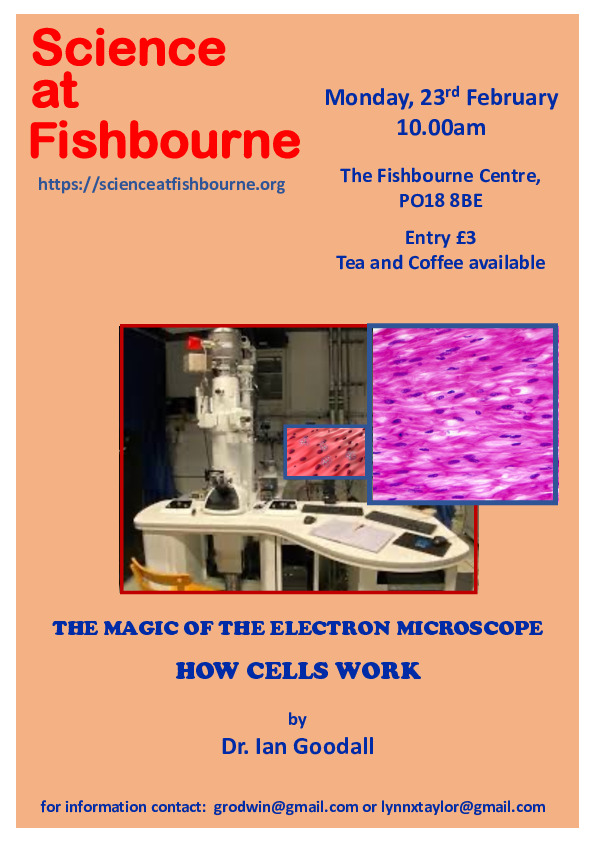
Dr Ian Goodall’s presentation to Science at Fishbourne this month, opened our eyes to how progress in technology has transformed our view of the living cell; how progress from the Light Microscope of the 1600s, to the Electron Microscope of today has given new insights into the cells that make us.
The work of Antonie van Leeuwenhoek (1632–1723) created single lens, hand held microscopes, capable of 50x-500x magnification and these microscopes enabled him to discover bacteria, protozoa, sperm, and red blood cells which he named: "Animalcules.”
It was Robert Hooke, an English scientist of the 17th Century, who coined the term, “Cell.”
When viewing thin slices of cork in a compound microscope -a microscope with two lenses- he observed box like structures which reminded him of Monks’ cells.
In these early days, little more than the cell nucleus and grainy cytoplasm could be seen. Today, electron microscopes are capable of showing amazing detail.
With some detailed slides, Ian enthralled us with these new discoveries about our own body cells. Our eukaryotic cells consist of membrane-bound organelles: The nucleus containing DNA is the largest and is considered as the control centre; other organelles include mitochondria, endoplasmic reticulum, Golgi apparatus, vesicles and vacuoles. Ribosomes, though not enclosed in a membrane, are also referred to as organelles.
Ian spoke of brain cells: neurones, which may each have 10,000 connections; muscle cells and phagocyte cells which form the gateway to the immune system, and through a process called: “Phagocytosis,” they can ingest and eliminate pathogens as well as apoptotic cells, so clearing the numerous cells that die off each day.
Killer T cells are specialised white blood cells, which are produced in the long bones of the body and mature in the Thymus, where B lymphocytes are converted to T lymphocytes. These killer T cells can directly kill virus infected cells and cancer cells.
The very large, very costly, Transmission Electron Microscopes work in a vacuum and samples are embedded in a glue like substance and inserted through an air lock. High voltage beams of electrons are fired down the vacuum column and through the thin specimen. The wave length being 100th of a nanometre gives 1000 times more detail.
With the electron microscope, it’s possible to see the myosin and actin muscle fibres working to cause muscle contraction. Calcium ions are released in response to a nerve impulse and a cross bridge cycle occurs when myosin binds to actin, pulling filaments and causing contraction. ATP (Adenosine Triphosphate) provides energy to reset for the next cycle.
Sir Andrew Huxley (1917-2012), working at Cambridge, developed interference microscopy for muscle contraction research.
I think we were all spellbound by the slide which demonstrated the energy powerhouse within us; the Mitochondria, responsible for 90% of the body’s chemical energy. Mitochondria have two membranes; the inner membrane consists of many folds giving a surface area 5 times that of the outer membrane. F1 particles on the inner membrane (a crucial part of the enzyme ATP-adenosine triphosphate-) act like a turbine to generate energy, spinning at 8000 revs per minute. ATP is made on demand. It is used and recycled. We make our own body weight of ATP over a day. Each molecule is recycled 1000+ times a day!
Peter Michell was awarded the Nobel prize in 1978 for discovering this.
Mitochondria are very important; diseases can occur through mitochondria malfunction. They also have their own DNA. It was revealing to hear that an infant only receives the mitochondrial DNA from its mother and this mtDNA can be used to track ancestry.
Lynn Margulis (1936-2011) formed the theory that mitochondria came from endosymbiosis, and it took 12 years for her theory to be accepted. Her research revealed that an aerobic proteobacteria formed a symbiotic partnership with an anaerobic, host-like cell. The mitochondria protect the host cells; they are the energy powerhouse and the host cell provide shelter and raw materials.
Cilia in the lungs can be viewed as they move mucus away from the lungs. Hopefully smokers are aware that smoking kills these cilia. Their motion is like that of the sliding muscle fibres.
Flagella are longer and have rotary motor action rather like the turbine in the mitochondria. Many bacteria, such as cholera bacteria have flagella and they use ATP to spin.
Ribosomes synthesise proteins by collecting instructions copied from DNA to mRNA, then translating them into amino acids. Insulin acts as a hormone that promotes this translation.
The Golgi apparatus, was first observed by Camillo Golgi (1843-1926). It can be likened to the workings of a post office, as it sorts and packages proteins and lipids, then sends them off to work where needed. Lysosomes are produced in the Golgi apparatus. They perform a crucial role in breaking down waste materials, foreign invaders and old cell organelles. Lysosomes also play an important role in apoptosis -programmed cell death-. Lysosomes and Apoptosis are critical in the development of the human embryo. They are responsible for the separation of digits, neural development and the removal of vestigial structures.
The Cytoskeleton provides a structural framework for the cell. It also transports organelles and vesicles and is involved in cell division and movement.
Nerve cells transmit electrical and chemical signals throughout the body. When they die they cannot grow back. Nerve cell membranes are semi-permeable, phospholipid insulators, allowing signal transmission.
The Myelin sheath is a protein rich insulating layer. It is segmented, rather than continuous, so causing an increase in the speed of conduction as nerve impulses jump from node to node.
The mitochondria and chloroplasts found in plants were also formed through Endosymbiosis. The mitochondria convert sugars into energy, and chloroplasts make photosynthesis possible, so transforming the light energy from the sun into sugars.
Plants transport water from the roots to leaves via dead, hollow, xylem cells and move sugars from the leaves down the plant via living, phloem cells.
Ian ended his presentation with images from a Scanning Electron Microscope. These microscopes produce high resolution 3D like images, of a samples surface, using a focused electron beam. It allows a larger portion of a specimen to be in focus at any one time, and there are many images to view on the internet.
We always welcome Dr Ian Goodall, and he gave -as always- a truly fascinating presentation, leaving us to reflect upon what makes us who we are.
I found this interesting link on the Internet:
https://humanbiology.pressbooks.tru.ca/chapter/4-6-cell-organelles/