Overview
One of the challenges experienced by fighter pilots is the high G forces caused by rapid combat manoeuvres. Opened in 1955, the Farnborough centrifuge was able to safely test human subjects under the effects of high G. For over 60 years, the centrifuge remained at the forefront of UK research and contributed to many world-leading technology advances.
Sue Adcock, a former research scientist, centrifuge subject and pilot (150 hrs in fast jets), will cover a brief history and description of the Farnborough centrifuge, describe the effects of high G on the human body and outline various ways of providing G protection.
Lynn’s Review
Sue Adcock had dreamed of working in military aviation from a young age. She may have been influenced by “Biggles” stories, and her talk to Science at Fishbourne was a testament to how early passions for a subject can direct and fuel future achievements.
Sue was always interested in the sciences at school and graduated with a degree in mathematics from Oxford University. She secured a position with the Royal Aircraft Establishment as a research scientist and, since then, she has had a wide career in aviation. She now volunteers for the Farnborough Air Sciences Trust which was set up in 1993 to preserve aviation heritage.
Sue’s presentation gave an interesting insight into early research on G forces, and as someone who can just about cope with swinging on a swing, my head was spinning from some of the excellent videos of Sue and her husband, an RAF Test Pilot, now retired, experiencing G forces.
As we aren’t designed to work with high G forces, it is no surprise that tight turns in Camel Aircraft during WWI led to problems for pilots, who experienced, “Fainting in the Air.”
This led, in WWII, to research, taking place, in aircraft in the air, using Spitfires and Hurricanes. Post war, pilots of jetfighters such as Hunter, Lightning Jets could expect to withstand a force of 9G. Research was therefore essential.
Centrifuges did exist in the 1930s, but it was 1944 when construction began on a centrifuge at Farnborough, at a cost of £350,000. The foundations for the building were 27ft deep, and the building process followed none of today’s Health and Safety measures.
The Farnborough Centrifuge, run by the RAF, was first used on 18th April 1955. It consists of 3 parts:
Part 1: The hall, having a diameter of 80ft, and a centrifuge arm 62½ ft long and 9½ ft wide with a gondola at each end. In the centre of the centrifuge arm are 2 seats for medical doctors to oversee the testing.
Beneath the hall is a pit with a direct current electric motor of 1,350 hp. The centrifuge arm is mounted on a 12 ton, 12ft diameter flywheel which sits on a spindle on the motor. There are 2 sets of 4 holding breaks to hold the centrifuge steady during operation. The rotating weight is 40 tons. The centrifuge is capable of achieving 30G unmanned and can go from
0-63mph in 6 seconds.
Part 2: The plant rooms consist of heavy machinery to generate power and speed. The centrifuge has its own substation; incoming AC power goes to a generator for DC in order to get a fine current. Thyratrons act as electrical switches to control the flow of energy.
Part 3: The Control Room is where the G operation, is set via RPM and G force dials. It also controls the communication system. A spring loaded knob sets the centrifuge to go from 1G to 6G for 15 seconds. It shuts off at the time limit. A device, such as this, was used in the 1950s/60s for operating lifts and has been repurposed for the centrifuge, with different Cams for each grade of G force. The discs are carefully made to run correctly; as the timer ticks down, the G force is shut off at 15 seconds.
There is also a Joystick for affecting change to the G force and a big red Stop Button!
The Farnborough Centrifuge is probably the oldest remaining centrifuge; however, it may not remain for many years longer, despite having an English Heritage star. In 2006 the site was sold off to build housing, but the centrifuge, having been awarded the English Heritage star, through Sue’s efforts, was left untouched. It is now surrounded by a housing estate. The current owner had been a receiving good rental income while the Centrifuge was in use, and tours to see the Farnborough model were happening, but they stopped in 2024, and a new centrifuge was built at RAF Cranwell in 2019. The Farnborough centrifuge is now up for sale and, sadly, in a state of general disrepair.
Sue outlined how G forces affect pilots and described actions taken to counter the affect. At 9G weight is increased by 9 times, so affecting mobility; blood pools in the legs and feet; there is a loss of vision followed by blackout and possible loss of consciousness; soft tissue can also be injured. Some pilots have died as a result of: G-Loc.
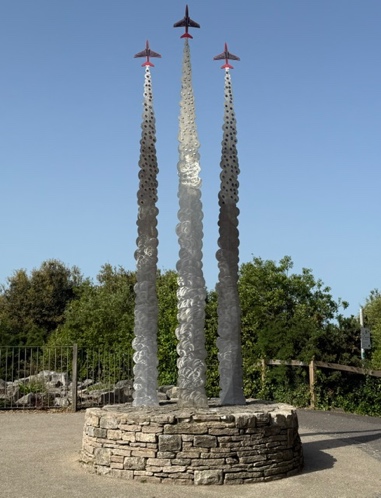
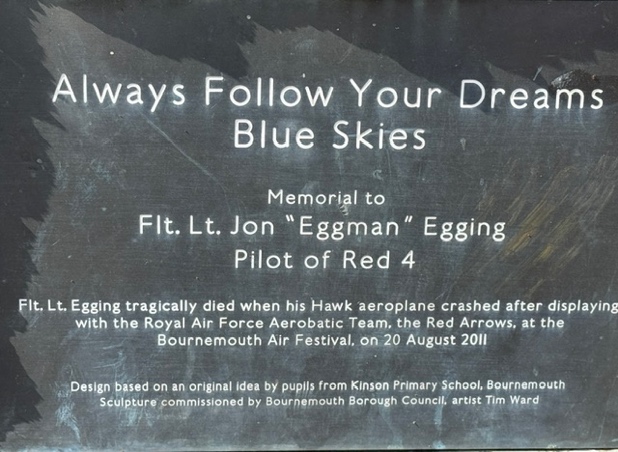
Flt. Lt. Jon Egging died in 2011 when his Hawk aeroplane crashed in Bournemouth during an RAF Red Arrows display.
The centrifuge had many test runs, possibly more than 122,000, to find solutions for pilots under G force.
Inflatable trousers brought some relief. These are worn over a flying suit and inflate over the legs as G increases, so stopping blood flow to the feet. Tornado and Harrier pilots in WWII wore these. They were generally effective from 3-5G.
Trousers covering the whole of the lower body were trialled. Having no cut outs to the knees and heels, there were mobility problems. Wearing these, could increase tolerance by 1G.
Sue’s husband, Terry Adcock, managed to achieve 9G with the trousers whilst also deploying the Anti-G straining manoeuvre. This has to be done correctly, and involves, tensing/straining the body whilst holding the breath for 3-4 seconds. The issue was: could this be achieved during combat?
A further addition was the introduction of breathing oxygen under pressure: Positive Pressure Breathing for G-force Protection (PBG). This was developed at Farnborough’s centrifuge, trialled in 1975, with 600 runs and reaching G force 9. Having made this work, the next step was to improve the design of the mask worn by the pilot.
Sue Adcock has clocked up 150 hours in fast jets, and 60 years as a flight tester. No mean achievement for a woman. She has been instrumental in the testing of tactics to ameliorate G force conditions in the centrifuge and also in the air; all since she gained her Private Pilot’s License in 1982.
The USA also sent their systems to Farnborough for testing and Sue is probably the first woman to have flow, “Combat Edge,” (more information on that can be found here: https://www.parallelparliament.co.uk/question/85423/air-force-training).
We all learnt much from Sue’s talk and I’m sure she will talk to us again in the future.
I was in Bournemouth last weekend, where I took photos of the memorial to Flt. Lt. Jon Egging. Whilst there I also had fun in the RAF G force simulator; suitable for 3 year olds so I knew it would be fine for me.